
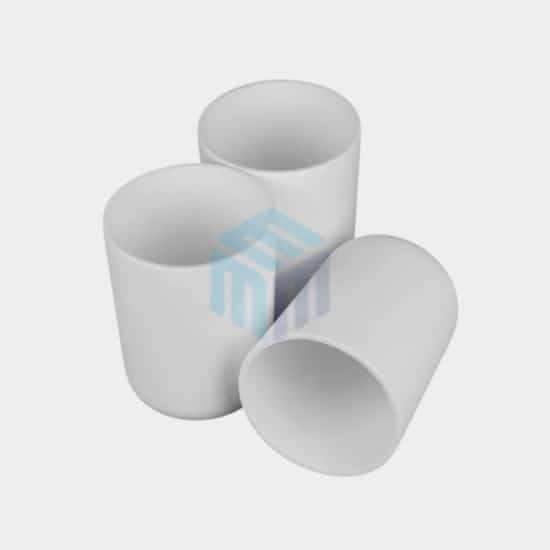
When working with high-temperature materials, selecting the right crucible can significantly impact process efficiency, sample purity, and equipment lifespan. Among advanced ceramic materials, zirconia crucibles are widely recognised for their exceptional thermal resistance and chemical stability.
However, not all zirconia crucibles are the same. Many laboratories and industrial users face an important question:
Should you choose a standard zirconia crucible or a yttria-stabilized zirconia (YSZ) crucible for extreme-temperature applications?
In this guide, we’ll compare both options and help you determine which material delivers the best performance under demanding conditions.
Why Zirconia Crucibles Are Used for High-Temperature Applications
Zirconia (ZrO₂) is one of the most advanced ceramic materials available today. Compared to alumina and many other technical ceramics, zirconia oxide crucibles offer:
- Extremely high melting temperature
- Excellent thermal shock resistance
- Low thermal conductivity
- Superior chemical inertness
- High mechanical strength
These properties make zirconia crucibles suitable for:
- Precious metal melting
- Advanced ceramics processing
- Glass manufacturing
- Thermal analysis
- Research laboratories
- High-temperature material testing
What Is a Standard Zirconia Crucible?
A standard zirconia crucible is manufactured primarily from zirconium dioxide without significant stabilising additives.
While it offers excellent heat resistance, pure zirconia undergoes phase transformations when heated and cooled repeatedly. These structural changes can lead to:
- Dimensional instability
- Microcracking
- Reduced mechanical strength over time
For moderate-temperature applications, standard zirconia performs well. However, challenges can arise during repeated thermal cycling at extreme temperatures.
What Is a Yttria-Stabilized Zirconia (YSZ) Crucible?
Yttria-stabilized zirconia contains small amounts of yttrium oxide (Y₂O₃) added to the zirconia structure.
This stabilisation prevents the crystal phase changes that occur in pure zirconia.
As a result, YSZ crucibles offer:
- Improved thermal stability
- Enhanced fracture toughness
- Better thermal shock resistance
- Greater structural reliability
- Longer service life
For demanding industrial and laboratory applications, YSZ has become the preferred choice.
Thermal Stability Comparison:Yttria-Stabilized vs Standard Zirconia Crucibles
Standard Zirconia
Standard zirconia performs well at high temperatures but may experience phase transformations during repeated heating and cooling cycles.
Potential issues include:
- Volume expansion
- Surface cracking
- Reduced lifespan
Yttria-Stabilized Zirconia
YSZ maintains a stable crystal structure across a broader temperature range.
Benefits include:
- Consistent performance
- Reduced cracking risk
- Improved dimensional stability
For applications involving frequent thermal cycling, YSZ generally outperforms standard zirconia.
Thermal Shock Resistance: Yttria-Stabilized vs Standard Zirconia Crucibles
Rapid temperature changes can damage many ceramic materials.
Standard Zirconia
Offers good thermal shock resistance but can become vulnerable after repeated thermal cycling.
Yttria-Stabilized Zirconia
Provides superior thermal shock resistance due to its stabilised crystal structure.
Thermal Cycling: YSZ vs Standard Zirconia
Thermal cycling is an important consideration when selecting a zirconia crucible for processes involving repeated heating and cooling. The main difference between yttria-stabilized zirconia (YSZ) and standard zirconia is their response to temperature-driven phase transformations.
Standard zirconia can undergo phase transformations as temperature changes. These transformations are associated with changes in crystal structure and volume, which can generate internal stresses and increase the risk of cracking during repeated thermal cycles. Yttria stabilization helps maintain a more stable zirconia phase over the intended operating range, reducing transformation-related dimensional changes.
| Thermal Cycling Factor | YSZ Crucible | Standard Zirconia Crucible |
|---|---|---|
| Phase Stability | Higher | More susceptible to phase transformation |
| Repeated Heating/Cooling | Generally better suited | Requires greater consideration |
| Transformation-Related Stress | Reduced | Can be higher |
| Dimensional Stability | Generally better | More affected by phase changes |
| Thermal Shock Behaviour | Grade and geometry dependent | More sensitive to transformation effects |
| Suitable Applications | Repeated thermal cycling and demanding processes | Stable high-temperature processes with controlled cycling |
However, YSZ is not automatically immune to thermal shock or cracking. Performance also depends on crucible geometry, wall thickness, heating and cooling rates, temperature gradients, furnace atmosphere, and the number of thermal cycles.
Chemical Compatibility of YSZ and Standard Zirconia
Both yttria-stabilized zirconia (YSZ) and standard zirconia offer good chemical stability at elevated temperatures, but their suitability depends on the material being processed, temperature, atmosphere, exposure time, and crucible grade. A zirconia crucible should therefore be selected based on the complete process environment rather than chemical resistance alone.
| Chemical Consideration | YSZ | Standard Zirconia |
|---|---|---|
| High-temperature chemical stability | Excellent, application dependent | Excellent, application dependent |
| Molten-metal exposure | Depends on metal and temperature | Depends on metal and temperature |
| Oxide-containing materials | Generally suitable for many applications | Generally suitable |
| Reactive compounds | Compatibility should be verified | Compatibility should be verified |
| Acids/alkalis | Depends strongly on concentration and temperature | Depends strongly on concentration and temperature |
| Vacuum processing | Suitable with appropriate grade | Suitable with appropriate grade |
| Contamination-sensitive processing | High-purity grades available | High-purity grades available |
For demanding or contamination-sensitive processes, a material compatibility evaluation or application-specific testing is recommended rather than relying solely on general chemical-resistance ratings.
Zirconia Crucible Purity and Stabilizer Selection
Zirconia purity and stabilizer content affect thermal stability, chemical resistance, mechanical strength, and contamination control. High-purity zirconia is preferred for sensitive laboratory and high-temperature applications where impurities can affect the process.
Yttria-stabilized zirconia (YSZ) is often selected for applications involving repeated thermal cycling because yttria improves phase stability. Standard zirconia can be suitable for controlled high-temperature applications where stabilization is not essential.
When selecting a zirconia crucible, consider purity, yttria content, operating temperature, thermal cycling, chemical compatibility, and contamination requirements.
Which Applications Benefit Most from YSZ Crucibles?
Yttria-stabilized zirconia crucibles are commonly used for:
Precious Metal Melting
Gold, platinum, and specialty alloy processing.
Advanced Ceramic Manufacturing
High-purity ceramic powders and sintering applications.
Semiconductor Processing
High-purity thermal applications requiring minimal contamination.
Thermal Analysis Laboratories
Repeated heating cycles where dimensional stability is critical.
Is the Higher Price Worth It?
When comparing zirconia crucible price, YSZ crucibles are typically more expensive than standard zirconia versions.
For high-value processes, the additional investment often pays for itself through improved durability and performance.
Choosing the Right Zirconia Crucible
Consider the following factors:
Choose Standard Zirconia If:
- Operating temperatures are moderate
- Thermal cycling is limited
- Budget is a primary concern
Choose Yttria-Stabilized Zirconia If:
- Extreme temperatures are involved
- Frequent heating and cooling cycles occur
- Maximum durability is required
- Process reliability is critical
A trusted zirconia crucibles supplier can help determine the most suitable option for your application.
Conclusion
Both standard and yttria-stabilized zirconia crucibles offer outstanding high-temperature performance. However, when applications involve extreme temperatures, rapid thermal cycling, or long operational lifespans, yttria-stabilized zirconia crucibles generally provide superior reliability.
Their enhanced toughness, thermal stability, and resistance to cracking make them the preferred choice for advanced laboratories, materials research facilities, and industrial processing operations.
For critical high-temperature applications, investing in the right zirconia oxide crucible can significantly improve process efficiency and reduce long-term operating costs.
Looking for high-performance zirconia crucibles for demanding thermal applications? 👉 📞 Contact +61-478-594-746 or 📧 email info@mkube.com.au for premium zirconia solutions tailored to your requirements across Australia.