


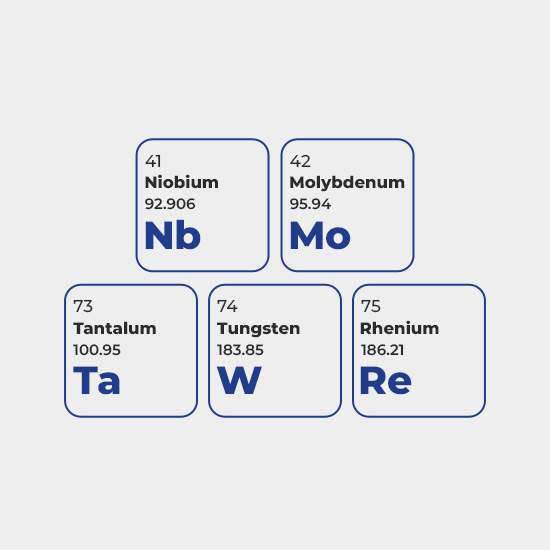
Choosing the right refractory metal is critical for ensuring performance, reliability, and cost-efficiency in high-temperature and demanding industrial environments. Metals such as tungsten, molybdenum, tantalum, niobium, and rhenium are known for their exceptional resistance to heat, wear, and corrosion but selecting the right one depends on far more than just melting point.
Each refractory metal offers a unique combination of thermal stability, mechanical strength, chemical resistance, and machinability. The wrong choice can lead to premature failure, increased maintenance costs, or compromised product performance. That’s why engineers, manufacturers, and procurement teams must carefully evaluate application requirements before making a decision.
In this complete guide, we break down the key factors to consider when choosing a refractory metal, compare the properties of the most commonly used materials, and provide practical insights to help you select the best option for your specific application.
What Are Refractory Metals? Properties, Types & Applications
Refractory metals are a group of metallic elements known for their exceptionally high melting points, strong mechanical performance at elevated temperatures, and resistance to wear, deformation, and chemical attack. These characteristics make them indispensable in industries where conventional metals fail under extreme heat or harsh environments.
Common refractory metals include tungsten, molybdenum, tantalum, niobium, and rhenium, each offering unique performance advantages depending on application requirements.
Definition and Key Properties
Refractory metals are defined by their melting points above 2,000°C, significantly higher than most structural metals. Beyond temperature resistance, they exhibit a combination of properties that enable reliable performance in demanding conditions:
-
Extremely high melting points – Tungsten, for example, melts at approximately 3,422°C, the highest of all metals.
-
Excellent high-temperature strength – These metals retain mechanical integrity and resist creep at temperatures where other materials soften or deform.
-
Low vapor pressure – Essential for vacuum and high-temperature furnace applications.
-
Good thermal and electrical conductivity – Particularly important in electronics and heating elements components.
-
Resistance to wear and deformation – Maintains dimensional stability under stress.
-
Chemical stability – Many refractory metals resist corrosion and chemical attack, especially in inert or vacuum environments.
However, most refractory metals require protective atmospheres or coatings at high temperatures, as they can oxidize rapidly in air.
Why Refractory Metals Matter in High-Temperature Applications
Refractory metals play a critical role in applications where extreme temperatures, high stress, and precision performance are unavoidable. In industries such as electronics, energy, and advanced manufacturing, these metals enable processes that would otherwise be impossible.
Key reasons they are essential include:
-
Reliability at extreme heat – Components made from refractory metals continue to function where conventional alloys fail.
-
Dimensional stability – Critical for precision parts in semiconductor manufacturing and high-temperature tooling.
-
Performance in harsh environments – Ideal for vacuum systems, corrosive atmospheres, and high-energy applications.
-
Extended service life – Reduced deformation and failure rates lead to lower maintenance and replacement costs.
-
Compatibility with advanced technologies – Used in rocket nozzles, furnace components, heating elements, crucibles, and medical imaging equipment.
By understanding what refractory metals are and why they are used, engineers and decision-makers can better evaluate which material best suits their temperature requirements, mechanical demands, and operating environment.
Key Factors to Consider When Selecting Refractory Metals (Complete Checklist)
Selecting the right refractory metal is crucial for achieving optimal performance in high-temperature and demanding environments. With options like tungsten, molybdenum, tantalum, and niobium, each offering unique strengths in thermal stability, corrosion resistance, and mechanical durability, making the right choice can be challenging. Refractory metals, such as tungsten, molybdenum, tantalum, niobium, and rhenium, have unique properties and applications. Here’s a guide to help you choose the appropriate refractory metal:
- Temperature Requirements:
- Determine the maximum and minimum operating temperatures for your application. Different refractory metals
have different temperature limits, and you should choose one that can withstand the temperature range
required.
- Chemical Compatibility:
- Consider the chemical environment in which the material will be used. Some refractory metals are more resistant
to specific chemicals and corrosive agents than others. Choose a metal that is compatible with your
application’s chemicals.
- Mechanical Properties:
- Evaluate the mechanical properties such as strength, ductility, and hardness. Different refractory metals have
varying mechanical characteristics, which may be critical for your specific application.
- Thermal Conductivity:
- Depending on your application, you may need a refractory metal with good thermal conductivity or one with low
thermal conductivity. Consider the thermal properties that align with your needs.
- Electrical Conductivity:
- If electrical conductivity is important for your application, select a refractory metal that offers the required
electrical conductivity.
- Fabrication and Machinability:
- Consider the ease of machining and fabricating the refractory metal. Some metals are easier to work with than
others. Determine if the material can be easily shaped, cut, or formed to meet your needs.
- Strong Availability and Cost:
- Evaluate the availability and cost of the refractory metal. Some metals may be more readily available and
cost-effective than others, depending on your location and the quantity you need.
- Specific Applications:
- Refractory metals are often chosen based on their specific applications. For example:
- Tungsten is often used in high-temperature and radiation-shielding applications.
- Molybdenum is used in the electronics industries.
- Tantalum is known for its corrosion resistance and is used in chemical processing.
- Niobium is used in superconductors and the medical field.
- Rhenium is employed in high-temperature applications.
- Longevity and Durability:
- Consider the expected service life and durability of the refractory metal. Some materials are more resistant to
wear and degradation than others, which may be crucial for long-term use.
- Regulatory Compliance:
- Ensure that the selected refractory metal complies with any relevant regulations and safety standards for your
industry.
- Consultation:
- If you are uncertain about which refractory metal to choose, consider consulting with a materials engineer or a
specialist who can provide guidance based on your specific application requirements.
It’s important to thoroughly analyze all these factors and conduct a cost-benefit analysis to select the most suitable
refractory metal for your particular needs. The choice should be based on a careful assessment of the specific demands
of your application, as each refractory metal has its unique set of properties and limitations.
Refractory Metals Comparison: Tungsten vs Molybdenum vs Tantalum vs Niobium vs Rhenium
The table below compares the most commonly used refractory metals based on melting point, strength, conductivity, oxidation behavior, and typical applications. While exact performance can vary by grade and alloy, this overview provides a practical starting point for material selection.
| Refractory Metal | Melting Point (°C) | Key Strengths | Limitations | Common Applications |
|---|---|---|---|---|
| Tungsten (W) | ~3,422°C | Highest melting point of all metals, excellent high-temperature strength, low vapor pressure | Brittle at room temperature, oxidizes rapidly in air | Furnace heating elements, high-temperature tooling, vacuum applications |
| Molybdenum (Mo) | ~2,623°C | Good balance of strength, thermal conductivity, and machinability | Lower oxidation resistance than tungsten | Furnace parts, electrodes, heat shields, semiconductor equipment |
| Tantalum (Ta) | ~3,017°C | Exceptional corrosion resistance, excellent ductility | High cost, oxidizes at elevated temperatures | Chemical processing equipment, medical implants, electronics |
| Niobium (Nb) | ~2,477°C | Good formability, corrosion resistance, superconducting properties | Lower high-temperature strength compared to W and Mo | Superconducting magnets, electronics |
| Rhenium (Re) | ~3,186°C | Improves ductility and creep resistance when alloyed | Extremely expensive, limited availability | High-stress turbine components, thermocouples |
Below is ready-to-publish content with two structured tables that fit perfectly under your requested headings.
These tables are designed to improve SEO, scan ability, and decision-making, especially for engineers and buyers.
Refractory Metals Selection Decision Matrix
This decision matrix helps compare refractory metals across the most important performance and selection criteria. It allows users to quickly identify the most suitable material based on operating conditions, environment, and application demands.
Side-by-Side Property Comparison Table
The table below ranks common refractory metals qualitatively across key selection factors. This format is ideal for fast comparison and works well for users who do not require deep numerical data.
| Property / Metal | Tungsten (W) | Molybdenum (Mo) | Tantalum (Ta) | Niobium (Nb) | Rhenium (Re) |
|---|---|---|---|---|---|
| Maximum Temperature Capability | Excellent | Very Good | Excellent | Good | Excellent |
| High-Temperature Strength | Excellent | Very Good | Good | Good | Excellent |
| Oxidation Resistance | Poor (unprotected) | Poor (unprotected) | Very Good | Good | Poor |
| Thermal Conductivity | High | High | Moderate | Moderate | Moderate |
| Electrical Conductivity | High | High | Moderate | Moderate | High |
| Machinability | Difficult | Moderate | Good | Very Good | Difficult |
| Ductility at Room Temperature | Low | Moderate | High | High | Moderate |
| Cost & Availability | Moderate | Moderate | High | Moderate | Very High |
Key takeaway: No single refractory metal excels in all categories—selection depends on which properties are most critical for the application.
Best Refractory Metals for Different Applications (Use-Case Guide)
This table maps typical industrial and scientific applications to the most suitable refractory metals, helping users move from comparison to selection.
| Application / Use Case | Recommended Refractory Metal(s) | Reason for Selection |
|---|---|---|
| Ultra-high-temperature furnace components | Tungsten | Highest melting point and low vapor pressure |
| Vacuum and inert-atmosphere heating systems | Tungsten, Molybdenum | Stable at high temperatures with minimal vaporization |
| Semiconductor and electronics manufacturing | Molybdenum, Niobium | Good conductivity, dimensional stability |
| Chemical processing equipment | Tantalum | Exceptional corrosion and chemical resistance |
| Medical and biomedical devices | Tantalum | Biocompatibility and corrosion resistance |
| Superconducting applications | Niobium | Excellent superconducting properties |
| High-stress, high-temperature alloys | Rhenium (alloyed) | Enhances ductility and performance under stress |
How This Decision Matrix Helps
- Simplifies complex material choices into clear comparisons
- Supports engineering, procurement, and design decisions
- Improves user engagement and dwell time
- Enhances ranking potential for “refractory metals comparison” and “refractory metal selection guide” queries.
Conclusion:
In conclusion, choosing the right refractory metal depends on carefully balancing your application’s temperature requirements, chemical environment, mechanical stresses, and budget. By understanding the unique properties of metals like tungsten, molybdenum, tantalum, and niobium, you can make an informed decision that ensures both performance and cost-effectiveness. Ultimately, selecting the ideal material sets the foundation for reliable, long-lasting results in even the most demanding conditions.
M-Kube Enterprise is an Australian company catering customized laboratory products, laboratory consumables and laboratory solutions in Australia, New Zealand, Singapore, Malaysia, South Korea, India, Dubai, Philippines, Indonesia and Vietnam.