
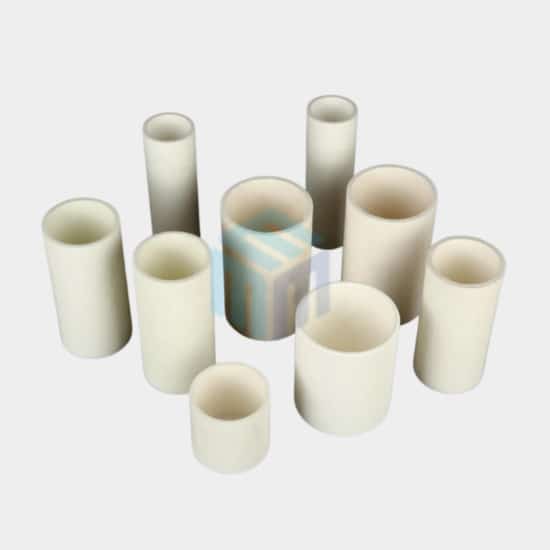
Selecting the right MgO ceramic components can have a major impact on equipment reliability, thermal efficiency, and operational costs. In industries such as metallurgy, laboratory testing, semiconductor processing, and advanced materials research, magnesium oxide (MgO) ceramics are valued for their excellent thermal resistance and electrical insulation properties.
When sourcing MgO ceramics, buyers often face an important decision: Should you choose standard off-the-shelf components or invest in Custom Magnesia Ceramic Parts?
The answer depends on your application, operating conditions, and performance requirements. In this article, we’ll compare both options and help you determine which solution delivers the best value.
What Are Off-the-Shelf MgO Ceramic Components?
Off-the-shelf components are standard products manufactured in fixed dimensions and specifications.
Examples include:
- Standard crucibles
- Tubes
- Plates
- Rods
- Insulators
Advantages include:
- Lower initial cost
- Faster availability
- Suitable for general-purpose applications
For routine operations with standard requirements, ready-made MgO ceramics may provide an economical solution.
What Are Custom Magnesia Ceramic Parts?
Custom Magnesia Ceramic Parts are specifically engineered to match a customer’s application requirements.
These components can be tailored for:
- Unique dimensions
- Special geometries
- Specific purity levels
- Thermal performance requirements
- Mechanical strength requirements
Examples include:
- Custom magnesia crucibles
- Custom magnesia tubes
- Custom magnesia plates
- Specialised furnace components
- Custom insulation assemblies
Customisation allows manufacturers to optimise component performance for specific operating conditions.
Custom vs Off-the-Shelf MgO Components: Performance Comparison
Fit and Dimensional Accuracy
One of the biggest advantages of Magnesium Oxide Custom Parts is precise dimensional control.
Custom components can:
- Eliminate installation issues
- Improve system integration
- Reduce assembly modifications
- Enhance equipment efficiency
In contrast, standard products may require compromises in design or performance.
Thermal Performance
High-temperature applications often require exact material specifications.
Custom designs allow engineers to optimise:
- Wall thickness
- Heat transfer characteristics
- Thermal shock resistance
- Temperature uniformity
This is especially important for custom magnesia crucibles used in demanding laboratory and industrial environments.
Mechanical Reliability
Poorly fitted components can experience:
- Uneven stress distribution
- Premature cracking
- Reduced lifespan
Custom-engineered MgO ceramic components are designed specifically for the intended application, often resulting in greater durability and reliability.
When Should You Choose Off-the-Shelf MgO Components?
Standard products are often suitable when:
- Operating conditions are relatively simple
- Industry-standard sizes are acceptable
- Budget is the primary concern
- Quick replacement is required
For routine laboratory applications, standard magnesia tubes or plates may perform adequately.
When Should You Choose Custom MgO Ceramic Parts?
Customisation becomes valuable when:
Extreme Temperatures Are Involved
High-temperature environments require precise engineering to minimise thermal stress.
Equipment Has Unique Dimensions
Custom components eliminate fitting issues and improve operational efficiency.
Process Purity Is Critical
Tailored material grades can reduce contamination risks.
Long Service Life Is Required
Optimised designs often provide greater durability than standard products.
In these situations, Magnesia custom ceramics often deliver superior long-term performance.
Common Custom MgO Ceramic Components and Applications
Custom Magnesia Tubes
Used for:
- Thermocouple protection
- Furnace applications
- High-temperature sensing systems
Custom Magnesia Plates
Used in:
- Insulation systems
- Furnace structures
- Electrical isolation applications
Magnesia Ceramic Rods Customization
Common in:
- Electrical heating systems
- Laboratory equipment
- Industrial processing systems
These customised solutions help maximise performance and system compatibility.
Custom vs Standard MgO Components: Cost vs Long-Term Value
At first glance, standard components may appear more economical.
However, custom components often reduce:
- Downtime
- Maintenance requirements
- Replacement frequency
- Energy losses
- Equipment modifications
For critical operations, the long-term value of Custom Magnesia Ceramic Parts often outweighs the higher initial investment.
Custom vs Off-the-Shelf MgO Ceramic Components Comparison Table
The choice between custom and off-the-shelf MgO ceramic components depends on your equipment design, operating conditions, dimensional requirements, and production volume. Standard components can be suitable for common applications, while custom parts offer greater control over fit and performance.
| Factor | Custom MgO Ceramic Components | Off-the-Shelf MgO Components |
|---|---|---|
| Dimensions | Manufactured to specified dimensions | Available in standard sizes |
| Tolerances | Can be tailored to application requirements | Limited to standard specifications |
| Material Grade | Grade and purity can be specified | Depends on available product |
| Design Flexibility | Suitable for complex or unique geometries | Generally limited to standard designs |
| Equipment Fit | Designed for precise equipment integration | May require adaptation |
| Lead Time | Usually longer due to manufacturing requirements | Generally faster availability |
| Initial Cost | Higher for specialised or low-volume parts | Usually lower for standard parts |
| Production Volume | Suitable for prototypes and specialised production | Ideal for routine replacement and standard applications |
| Best For | OEM equipment, specialised furnaces, custom assemblies | General-purpose and replacement applications |
For critical high-temperature applications, customisation can provide better dimensional compatibility and reduce problems associated with modifying standard components to fit specialised equipment.
How to Choose the Right MgO Ceramic Component
Selecting the right MgO ceramic component requires more than choosing a standard size. Consider the complete operating environment and the component’s mechanical, thermal, electrical, and dimensional requirements.
- Operating Temperature: Select an MgO material suitable for the actual operating temperature and thermal cycling conditions.
- MgO Purity and Grade: Higher-purity material may be preferred for applications where contamination control or specialised performance is important.
- Component Dimensions: Specify the required length, diameter, wall thickness, ID, OD, or other critical dimensions.
- Mechanical Requirements: Consider compressive loads, mounting forces, vibration, and handling conditions.
- Thermal Cycling: For applications involving frequent heating and cooling, select a component capable of handling the expected thermal stresses.
- Electrical Insulation: Where MgO is used as an electrical insulator, consider the required insulation performance and operating conditions.
- Chemical Environment: Check compatibility with gases, chemicals, molten materials, and process contaminants.
- Standard vs Custom Design: Choose an off-the-shelf component when a standard size meets the application requirements. Consider a custom component when precise dimensions, complex geometry, or specialised material specifications are required.
- Service Life: Consider expected operating hours, replacement frequency, and the cost of furnace downtime when evaluating the component.
- Supplier Capability: For custom parts, choose a supplier capable of producing the required dimensions, tolerances, material grade, and inspection documentation.
The right MgO ceramic component should provide a practical balance between thermal performance, dimensional accuracy, durability, application compatibility, and total cost.
Conclusion
Both standard and custom MgO ceramic components have their place in industrial and laboratory applications. Off-the-shelf products offer convenience and lower upfront costs, while Custom Magnesia Ceramic Parts provide optimised performance, improved reliability, and greater design flexibility.
For applications involving extreme temperatures, specialised equipment, or critical process requirements, Magnesium Oxide Custom Parts often deliver significant long-term advantages.
By partnering with an experienced Magnesia ceramic component supplier, businesses can obtain tailored MgO ceramic solutions that improve efficiency, extend component lifespan, and support demanding operating environments.
Need custom MgO ceramic components for high-temperature applications?
👉 📞 Contact +61-478-594-746 or 📧 email info@mkube.com.au for precision-engineered magnesia ceramic solutions across Australia.