
When analysing extremely low concentrations of chemicals, even the smallest measurement error can affect your results. Whether you’re performing environmental testing, pharmaceutical analysis, food quality control, or academic research, the accuracy of your spectrophotometer depends heavily on one often-overlooked component: the cuvette.
For UV-Vis spectroscopy and trace-level detection, Quartz Cuvettes are considered the gold standard. However, with various path lengths, volumes, and designs available, choosing the right cuvette isn’t always straightforward.
In this guide, we’ll explain how to select the best quartz cuvette for spectrophotometer applications and maximise accuracy when detecting low-concentration samples.
Why Quartz Cuvettes Are Preferred for Trace-Level UV-Vis Analysis
Unlike glass or plastic cuvettes, quartz offers excellent transmission in both the ultraviolet (UV) and visible regions.
Key advantages include:
- High UV transparency
- Excellent optical clarity
- Low background absorption
- Superior chemical resistance
- Long service life
These properties make UV quartz cuvette designs essential for applications where trace-level detection and high analytical sensitivity are required.
Why Quartz Cuvette Selection Matters in Trace-Level Detection
When analysing samples at very low concentrations, the spectrophotometer measures tiny changes in light absorption.
Using the wrong cuvette can lead to:
- Reduced sensitivity
- Higher background noise
- Poor repeatability
- Inaccurate concentration calculations
Selecting the proper UV Vis quartz cuvette helps ensure reliable and reproducible results.
Choosing Cuvette Path Length Based on Sample Concentration
The path length is one of the most important factors when selecting a cuvette.
10 mm (1 cm) Quartz Cuvette
The most common choice is the 1 cm quartz cuvette or 10mm quartz cuvette.
Benefits include:
- Industry-standard measurements
- Compatibility with most UV-Vis instruments
- Suitable for routine quantitative analysis
Most spectrophotometer methods are developed around a quartz cuvette 10mm path length.
Choose the Correct Sample Volume in Quartz Cuvettes
Sample volume becomes particularly important when working with expensive or limited samples.
Quartz Cuvette 1 mL
A quartz cuvette 1 ml is commonly used when sample availability is limited.
Ideal for:
- Pharmaceutical research
- Biochemical analysis
- High-value samples
Using the correct volume minimises waste while maintaining analytical accuracy.
Consider UV Transmission Performance
Not all cuvette materials transmit UV light equally.
Quartz provides excellent transmission down to approximately 190 nm, making it suitable for:
- DNA and RNA analysis
- Protein quantification
- Pharmaceutical testing
- Environmental contaminant analysis
For UV applications, a UV Vis quartz cuvette is essential because glass cuvettes often absorb UV wavelengths.
When Should You Use a Quartz Cuvette With a Lid?
For sensitive analyses, Quartz Cuvettes With Lid designs provide several benefits.
Advantages include:
- Reduced sample evaporation
- Lower contamination risk
- Improved repeatability
- Better handling of volatile samples
This is particularly useful for long scanning times and highly sensitive analytical methods.
Rectangular vs Other Cuvette Designs
Rectangular Cuvette
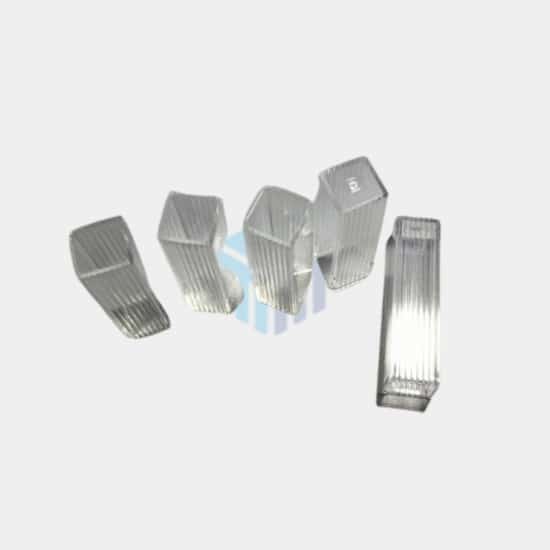
The rectangular cuvette is the industry standard for UV-Vis spectrophotometry and is widely used for quantitative analysis. Its flat optical windows and precise path length ensure consistent light transmission, making it the preferred choice for detecting low-concentration samples.
Benefits include:
- Consistent optical alignment with most UV-Vis spectrophotometers
- High measurement accuracy and repeatability
- Standard 10 mm path length for routine quantitative analysis
- Ideal for environmental, pharmaceutical, food, and research laboratories
Matched vs Unmatched Quartz Cuvettes
Matched quartz cuvettes are manufactured and selected to have closely comparable optical characteristics and path lengths. They can be useful when two or more cuvettes are used for reference and sample measurements.
| Feature | Matched Cuvettes | Unmatched Cuvettes |
|---|---|---|
| Optical consistency | Higher | May vary |
| Path-length consistency | Closely controlled | May have small differences |
| Comparative measurements | Preferred | Suitable for routine work |
| Trace-level analysis | Useful | Application dependent |
| Cost | Generally higher | Usually lower |
| Routine single-sample testing | May be unnecessary | Often sufficient |
For high-precision or comparative measurements, matched cuvettes can help reduce variation between sample and reference measurements. For routine analysis where the same cuvette is used consistently, an unmatched cuvette may be adequate.
Selection should therefore depend on measurement sensitivity, instrument requirements, path-length tolerance, and the level of accuracy required.
Other Quartz Cuvette Designs
Specialised quartz cuvettes are available for applications with unique analytical requirements. For example, micro-volume cuvettes are designed for analysing limited or expensive samples, while flow-through cuvettes support continuous sample monitoring in automated systems. Cylindrical cuvettes are commonly used in fluorescence spectroscopy, where measurements may require light collection from multiple directions.
Although these specialised designs are valuable for specific applications, they are generally not required for routine UV-Vis absorbance measurements.
Quartz Cuvette Cleaning and Inspection Before Analysis
Proper cleaning is essential for accurate UV-Vis measurements, especially when working with trace-level samples. Residue, fingerprints, dust, or scratches on the optical windows can affect light transmission and introduce measurement errors.
Before analysis:
- Rinse the cuvette with a compatible solvent or deionized water.
- Remove all visible sample residue.
- Avoid abrasive materials that can scratch the optical surfaces.
- Handle the cuvette by the frosted or non-optical surfaces.
- Check the optical windows for scratches, stains, chips, or cloudiness.
- Ensure no air bubbles are trapped in the measurement area.
- Confirm that the cuvette is completely clean and dry when required by the test method.
For trace-level analysis, inspect the cuvette before each measurement and replace it if scratches, cracks, permanent stains, or optical damage could affect measurement reliability.
Surface Quality and Optical Accuracy
For trace-level measurements, optical quality matters.
Look for:
- Precision-polished optical windows
- Tight dimensional tolerances
- Low optical distortion
- Scratch-free surfaces
High-quality polishing reduces stray light and improves analytical precision.
Chemical Compatibility of Quartz Cuvettes
Quartz has good resistance to many laboratory chemicals, which makes it widely used for UV-Vis analysis. However, quartz is not chemically inert to every substance, particularly under aggressive conditions.
Before selecting a quartz cuvette, consider:
- Sample pH: Highly acidic or alkaline solutions may require compatibility verification.
- Solvents: Confirm that the solvent will not damage the cuvette, seals, adhesives, or lid components.
- Concentration: Chemical effects can become more significant at higher concentrations.
- Temperature: Elevated temperatures can change chemical interaction and material performance.
- Exposure Time: Prolonged contact may produce different effects from short-term measurements.
- Cleaning Chemicals: Cleaning agents should be compatible with quartz and any non-quartz components.
- Reactive Samples: Strongly reactive chemicals should be evaluated before routine use.
For sensitive applications, verify compatibility using the actual chemical composition, concentration, temperature, and exposure time rather than relying only on general chemical-resistance tables. If the cuvette includes a lid, gasket, adhesive, or other components, their chemical compatibility should also be checked.
Is Price the Most Important Factor?
Many laboratories initially compare quartz cuvette price, but focusing solely on cost can be misleading.
Lower-quality cuvettes may result in:
- Optical inconsistencies
- Poor reproducibility
- Increased replacement frequency
For trace-level detection, optical performance and manufacturing quality often have a greater impact on overall value than initial purchase price.
Conclusion
Accurate trace-level chemical detection depends on more than just a high-quality spectrophotometer. Choosing the correct Quartz Cuvette can significantly improve sensitivity, repeatability, and overall analytical performance.
When selecting a cuvette, consider factors such as path length, sample volume, UV transmission requirements, optical quality, and sample handling needs. For most laboratory applications, a high-quality UV Vis quartz cuvette with appropriate specifications will deliver the best balance of performance and reliability.
By investing in the right cuvette, laboratories can achieve more precise measurements and greater confidence in their analytical results.