
Choosing the right sheet material is critical for equipment operating in seawater, chemical processing plants, desalination systems, heat exchangers, tanks, and other corrosive environments. Stainless steel is widely used because of its availability, strength, and relatively low initial cost. However, titanium sheet offers a different combination of corrosion resistance, low density, strength, and long-term durability that can make it the better choice in demanding environments.
Titanium vs Stainless Steel: A Quick Comparison
| Property | Titanium | Stainless Steel |
|---|---|---|
| Corrosion Resistance | Excellent in many aggressive environments | Excellent, but grade dependent |
| Seawater Resistance | Exceptional | Varies by grade |
| Weight | Low density | Higher density |
| Strength-to-Weight Ratio | Excellent | Good |
| Chloride Resistance | Excellent for suitable grades | Depends strongly on grade |
| Chemical Processing | Excellent for selected environments | Good to excellent depending on chemistry |
| Initial Material Cost | Generally higher | Generally lower |
| Long-Term Maintenance | Potentially low | Depends on environment |
| Fabrication | Requires specialised practices | Generally easier |
| Marine Applications | Excellent | Widely used |
The important point is that stainless steel is not one material. Grades such as 304, 316, duplex, and super duplex have different corrosion resistance and mechanical properties. Similarly, titanium grades should be selected according to the actual service environment.
Why Titanium Performs So Well in Marine Applications
Marine environments are particularly challenging because seawater contains chloride ions that can promote pitting and crevice corrosion in susceptible metals.
Titanium forms a stable, adherent oxide layer that provides exceptional protection against seawater corrosion. The International Titanium Association reports that commercially pure titanium has demonstrated strong resistance to general corrosion in seawater, while titanium has also been used extensively in seawater pumps, cooling systems, piping, and desalination equipment.
Titanium Sheet vs Stainless Steel Sheet in Seawater
Corrosion Resistance
For demanding seawater applications, titanium can provide a significant advantage.
Titanium’s passive oxide layer protects the material from many forms of corrosion. Long-term seawater exposure data and show extremely low corrosion rates for unalloyed titanium and Ti-6Al-4V.
Stainless steel can also perform well in marine applications, particularly when appropriate grades such as duplex or super duplex stainless steel are selected. However, chloride exposure can create risks such as:
- Pitting corrosion
- Crevice corrosion
- Stress corrosion cracking
The actual performance depends on grade, temperature, chloride concentration, flow conditions, and system design.
Advantage: Titanium for highly demanding seawater environments.
Titanium in Chemical Processing
Chemical processing environments can expose materials to acids, chlorides, oxidising solutions, organic chemicals, and elevated temperatures.
Titanium is widely used in chemical processing because of its strong corrosion resistance in many process environments. The International Titanium Association identifies applications in chemical processing, petrochemical operations, pressure vessels, and related process equipment.
The chemical-processing engineers increasingly select titanium to improve equipment life and reduce life-cycle costs.
However, titanium is not universally resistant to every chemical. Material selection should always be based on the actual chemical composition, concentration, temperature, flow conditions, and potential contaminants.
Understanding Titanium Sheet Grades
One of the most important considerations when selecting titanium sheet grades is whether you need commercially pure titanium or a titanium alloy.
Commercially Pure Titanium Grades
Commercially pure titanium grades are commonly selected when corrosion resistance and formability are more important than maximum mechanical strength.
Grades 1, 2, and 3 are commercially pure titanium grades with different mechanical properties.
Grade 2 is widely used for industrial corrosion-resistant applications because it provides a useful combination of strength, ductility, and corrosion resistance.
Titanium Grade 5
Grade 5, commonly known as Ti-6Al-4V, is one of the best-known titanium alloys.
It provides:
- High strength
- Excellent strength-to-weight ratio
- Good corrosion resistance
- Good fatigue performance
It is particularly important when structural strength is a major design requirement.
However, for certain chemical-processing and seawater applications, commercially pure titanium may be preferred depending on the environment and fabrication requirements.
Titanium Alloy Sheet vs Pure Titanium Sheet
Choosing between titanium alloy sheet and commercially pure titanium depends on the application’s priorities.
Choose Pure Titanium When You Need:
- Excellent corrosion resistance
- Good formability
- Seawater service
- Chemical processing
- Heat-exchanger applications
Choose Titanium Alloy Sheet When You Need:
- Higher mechanical strength
- Higher strength-to-weight ratio
- Structural performance
- Aerospace or high-performance engineering applications
The best material is therefore not necessarily the strongest material. It should be the grade that provides the required performance for the specific operating environment.
Thin Titanium Sheet for Marine and Chemical Applications
A thin titanium sheet can provide excellent corrosion resistance while reducing component weight.
Titanium’s relatively low density compared with many engineering metals can help engineers reduce weight without sacrificing corrosion performance.
Thin titanium products may be used for:
- Heat exchanger components
- Liners
- Chemical processing equipment
- Marine panels
- Fabricated components
- Laboratory equipment
- Specialised enclosures
The required thickness should always be determined from the application’s mechanical, pressure, corrosion, fabrication, and regulatory requirements.
Titanium Sheet Plate: Sheet vs Plate
The terms sheet and plate generally refer to flat titanium products distinguished by thickness, although exact dimensional classifications depend on the applicable standard.
A titanium sheet plate may be supplied in various thicknesses and dimensions according to the required specification.
For larger structural or pressure-containing applications, engineers may require thicker titanium plates.
For example, supplies titanium plates across a broad range of gauges and tolerances, including commercially pure titanium and Ti-6Al-4V.
Titanium Foil Sheet for Specialised Applications
A titanium foil sheet is an extremely thin titanium product used where low weight, corrosion resistance, and precise material thickness are important.
Potential applications include:
- Laboratory components
- Specialised chemical equipment
- Electronic applications
- Research equipment
- Thin protective liners
- Precision engineering
When specifying titanium foil, thickness tolerance, grade, surface condition, and dimensional requirements become particularly important.
When Should You Choose Stainless Steel?
Stainless steel remains an excellent engineering material and may be the better choice when:
- The environment is not highly corrosive
- Standard grades provide adequate corrosion resistance
- Initial cost is a major consideration
- Easy fabrication is important
- Material availability is critical
- High strength is required at a competitive cost
For many general industrial applications, stainless steel provides an excellent balance of cost and performance.
However, when chloride exposure, seawater, or aggressive chemical conditions create a significant corrosion risk, titanium deserves serious consideration.
When Should You Choose Titanium?
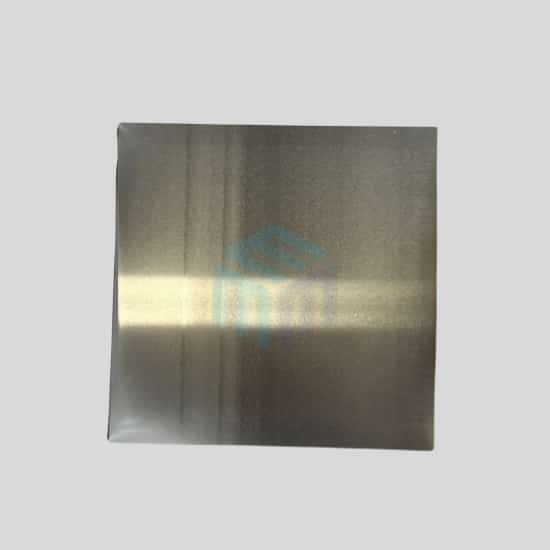
A titanium sheet is particularly attractive when your application requires:
Exceptional Seawater Resistance
Ideal for desalination, marine cooling, piping, and seawater heat-exchange systems.
High Corrosion Resistance
Suitable for selected chemical-processing environments where conventional stainless steels may have limitations.
Lightweight Construction
Titanium offers a high strength-to-weight ratio and lower density than many conventional engineering metals.
Long Service Life
Excellent corrosion resistance can reduce replacement requirements and maintenance in suitable applications.
Titanium Sheets for Sale: What Should You Check?
If you are searching for titanium sheets for sale, don’t compare suppliers on price alone.
Check:
- Titanium grade
- Sheet or plate thickness
- Dimensions
- Surface finish
- Material certification
- Applicable standards
- Quantity
- Custom cutting availability
- Delivery requirements
This is particularly important for chemical-processing and marine applications where material specification directly affects equipment performance.
Conclusion
There is no universal winner between titanium and stainless steel. The right material depends on the operating environment and the performance requirements of the equipment.
For demanding marine and chemical-processing applications, titanium metal sheet can provide a major advantage through its exceptional corrosion resistance, low density, and long service life. Titanium has a proven history in seawater piping, desalination, chemical processing, heat exchangers, and other challenging industrial environments.
Stainless steel remains a highly capable and cost-effective material for many applications, particularly where the environment does not justify the additional investment in titanium.
For engineers considering titanium sheet price, the best approach is to look beyond initial purchase cost and evaluate total lifecycle performance. With the right titanium sheet grades, thickness, and material specification, titanium can deliver reliable performance in environments where corrosion resistance is critical.
Looking for high-quality titanium sheet, thin titanium sheet, titanium alloy sheet, or titanium foil sheet for marine, chemical-processing, or industrial applications?
📞 Contact +61-478-594-746 or 📧 email info@mkube.com.au for titanium sheets and plates available in different grades, thicknesses, and sizes to suit your application requirements.