
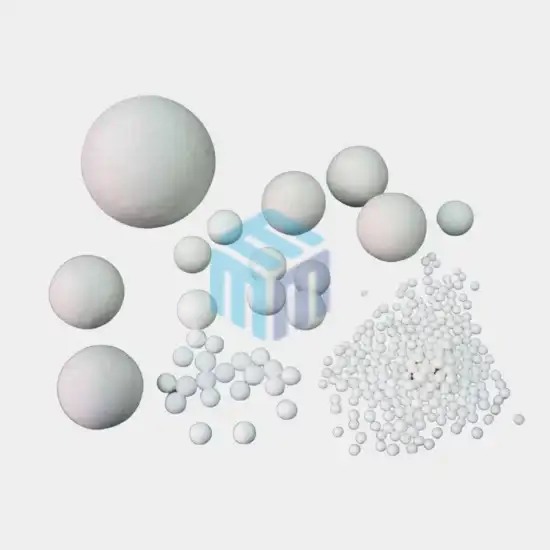
If you’re operating a grinding mill in Australia and evaluating your grinding media options, you’ve likely come across the debate between choosing 92 % alumina vs 99 % alumina. In this blog we’ll walk through the key differences, cost-vs-benefit implications, and what that means for your bottom line when choosing alumina grinding media (or alumina ceramic grinding media, alumina ceramic grinding balls, alumina milling media, alumina ceramic grinding beads, alumina grinding beads, alumina ball mill, alumina milling balls, and alumina grinding balls.)
When you’re selecting grinding media for your milling or mineral processing operations, the temptation is to go for the “highest specification” grade. But higher purity often comes with higher cost. The question is: Does 99 % alumina offer enough performance uplift compared to 92 % alumina to justify the extra cost — especially when ROI (return on investment) is considered? This blog will dig into the answers.
Key Properties of Alumina Grinding Media
These properties make alumina grinding media suitable for applications in ceramics, mining, pigments, and advanced material processing.
| Property | Key Benefit |
|---|---|
| High Hardness | Ensures effective grinding and particle size reduction. |
| Excellent Wear Resistance | Provides longer service life and reduces replacement frequency. |
| High Density | Improves grinding efficiency and impact energy. |
| Chemical Stability | Resistant to many chemicals and prevents reactions with materials. |
| Low Contamination | High purity minimizes impurities in the final product. |
| Thermal Stability | Performs well in high-temperature milling processes. |
Key Differences Between 92 % and 99 % Alumina Grinding Media
What do the purity numbers signify?
When we say “92 % alumina” vs “99 % alumina”, we’re referring to the aluminium oxide (Al₂O₃) content in the ceramic grinding media. Higher purity means fewer impurities, less glassy phase, higher density (in many cases), and improved mechanical/thermal properties. For instance:
- One study comparing 92 % and 99 % Al₂O₃ found markedly higher thermal conductivity and slightly better fracture toughness for the 99 % grade.
- A general overview of alumina ceramics shows that higher purity correlates with better strength, wear resistance, and corrosion resistance.
How do these differences play out for grinding media?
Here are practical performance attributes you need to assess:
| Attribute | 92 % Alumina | 99 % Alumina |
|---|---|---|
| Density & mass of media | Typically slightly lower than 99 % grade (less Al₂O₃, possibly more glass/impurity phases) | Higher density, more consistent hard phase -> better energy transfer |
| Hardness & toughness | Good, but may include more residual glassy phase | Superior hardness, fewer weak intergranular phases |
| Wear resistance (abrasion/impact) | Very good; “high alumina” ball media (92 %) show wear loss ≤ 0.01% in some sources. | Better still; less wear means longer life, fewer replacements, lower contamination |
| Contamination risk (from media into product) | Slightly higher risk owing to more impurity phases or glass | Lower risk — critical when product purity is vital (e.g., pigments, electronics) |
| Cost | Lower upfront cost | Higher upfront cost |
| Typical use-cases | General industrial milling (minerals, ceramics, glass) | Ultra-high purity applications (electronics, pharma, specialised chemicals) |
ROI Considerations for Australian Milling Operations
Let’s focus on the practicalities: you operate a grinding mill in Australia, you need reliable grinding media, you want the best ROI.
Upfront cost vs lifecycle cost
- Upfront cost: 99 % alumina media typically cost more per kg (due to higher raw material cost, processing, precision manufacturing).
- Lifecycle cost: Consider how often you have to replace media, downtime costs, contamination or reject costs, mill energy costs, maintenance costs. If 99 % saves you many replacements, that may offset the higher upfront cost.
Wear life & replacement frequency
If 92 % alumina gives you a certain number of hours of operation before replacement and 99 % gives significantly more, you need to translate that into cost per hour of milling. For example, one source claims 92 % alumina balls increased life from 2 years to 6-8 years compared to natural stone balls; though that’s versus stone not vs 99% alumina. 99% grade, you might expect even longer life — but you must verify actual mill conditions.
Contamination risk & product value
In Australia, if you’re grinding high value or ultra-pure products (fine ceramics, electronics, pigments, battery materials), contamination from media can cost you dearly (rejects, rework, product failure). In such cases 99 % alumina may pay off. If you’re grinding more tolerant materials (e.g., general mining ore), 92 % may suffice.
Energy efficiency & throughput
Higher density media (often associated with higher purity) deliver better energy transfer in the mill. That may reduce grinding time or energy consumption. Over many hours of operation, that adds up. For example, a guide says alumina balls have “bulk density typically 3.6-3.8 g/cm³ … high energy transfer during grinding.” If 99 % grade gives you higher or more consistent density, that can translate into throughput gains, lower cost per tonne.
Local service & supply chain in Australia
Don’t forget Australian logistics: shipping, import duties, inventory cost. If a 92 % grade is more locally available, shorter lead time, lower freight cost — that affects ROI. Also supplier support, media optimisation, and local spares matter.
Practical Aussie case: when 92 % makes sense
- You’re grinding ores, mineral raw materials where slight contamination or wear is not critical.
- Your volume is high, but margin per tonne is modest. The lower upfront cost and acceptable life may deliver better ROI.
- Your mill downtime cost is moderate, replacement cost is manageable.
Practical Aussie case: when 99 % makes sense
- You’re in fine ceramics, electronic materials, battery materials or pigments where purity is essential.
- Your margin per tonne is high. Rejects or contamination carry heavy cost.
- Your mill is high-precision, you want minimal downtime, long media life, high throughput, high product value.
What Should You Choose? : A Step-by-Step Approach
Choose based on your application needs: start by identifying required purity and performance levels. Then consider budget and operating conditions opt for higher-grade media for precision work, and standard options for cost-effective, general use.
- Profile your milling process
- What material are you grinding (ore, ceramic, pigment, battery)?
- What contamination tolerance do you have?
- What are your costs of media replacement, downtime, energy, rejects?
- Collect performance data
- From your current media run life (hours, tonnes, cost)
- Check wear loss, replacement frequency
- Measure contamination or product quality impact
- Assess energy consumption, throughput
- Estimate incremental cost & benefit
- What is the extra cost per kg for 99 % vs 92 % media?
- Project longer life of 99 % media (e.g., 1.3×, 1.5×, 2×) — conservative assumptions.
- Estimate savings: fewer replacements, less downtime, less contamination, higher throughput.
- Calculate cost per tonne processed
- (Media cost + downtime + rejects + energy) ÷ tonnes processed
- Compare for 92 % scenario vs 99 % scenario
- The one with lower cost per tonne (or higher margin) gives better ROI.
- Factor in supply chain & Australian context
- Are the 99% media readily available in Australia? What’s lead time?
- Can your budget support higher upfront cost?
- What’s your risk tolerance for downtime or contamination?
- Pilot or test
- If possible, trial a small batch of 99% media, monitor performance in your actual mill environment in Australia.
- Validate assumptions before full roll-out.
Common Mistakes When Choosing Alumina Grinding Media
Choosing based only on cost without considering wear resistance and performance can lead to frequent replacements. Ignoring purity requirements or application conditions may result in contamination or inefficient grinding.
- Choosing based only on purity percentage
- Assuming 99% alumina is always better
- Not matching purity level with actual application needs
- Focusing only on upfront cost
- Ignoring total lifecycle cost
- Overlooking frequent replacement and downtime expenses
- Not considering application requirements
- Using the same media for all industries
- Ignoring differences between bulk grinding and high-purity applications
- Overlooking wear rate and lifespan
- Selecting media that wears out too quickly
- Increasing maintenance and replacement frequency
- Ignoring density and grinding efficiency
- Not optimizing media for mill performance
- Missing out on better throughput and energy efficiency
- Failing to test in real conditions
- Relying only on supplier data or specifications
- Skipping pilot or trial testing before full-scale use
- Neglecting contamination risks
- Using lower-grade media in high-purity processes
- Risking product quality and rejection
- Not calculating return on investment (ROI)
- Missing the bigger picture of cost vs performance
- Choosing cheaper media that costs more in the long run
- Ignoring supplier quality and consistency
- Not verifying manufacturing standards
- Risking inconsistent batch performance
Summary – Which Gives Best ROI for You?
In many Australian industrial milling operations (especially standard mining, ceramic bulk grinding), 92 % alumina grinding media offers an excellent balance of cost, performance and supply flexibility. If your process does not demand ultra-high purity or extreme wear life, 92% may be the smarter ROI choice.
However, if your operation involves high-value product, critical purity, tight contamination limits, high throughput and long campaigns between media changes — then upgrading to 99 % alumina grinding media may deliver superior ROI by reducing total cost per tonne processed, not just upfront cost.
In short: don’t pick based purely on specification. Pick based on process requirements, actual cost-benefit, and Australian supply/logistics reality.
Conclusion
Choosing between 92 % and 99 % alumina grinding media is not just a matter of selecting the “higher number” — it’s about matching the right grade to your specific milling context, process demands and cost structure. For many Australian operators, 92 % will provide very good performance at a lower upfront cost and deliver solid ROI. But for high-value, high-precision applications where contamination control, media life and throughput matter most, 99 % alumina may deliver the better overall ROI.
References:
1) How to Choose the Right Alumina Grinding Ball for Your Process? (Win-Ceramic)
2) Guide to Alumina Grinding Balls: Properties, Applications, and Selection (Precise Ceramic)
3) Performance and Application of 92 Alumina Grinding Ball (Alumina Ceramic)
4) Processing of alumina grinding media using scandia as a sintering aid (The Americal Ceramic Society)